


Disease-carrying mosquitoes 'on the rise'
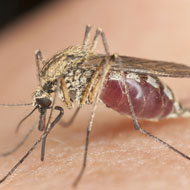
In just a few decades, disease-carrying mosquitos could become widespread in large parts of Britain.
Rising temperatures in the UK could accelerate the emergence of diseases including West Nile virus, dengue fever and chikungunya, public health experts warn.
Vector-borne diseases, which are transmitted by insects such as mosquitoes and ticks, are on the rise, according to a review being published in The Lancet Infectious Diseases journal. Over the past 10 years, they have spread into new parts of Europe - for example malaria in Greece, West Nile virus in eastern Europe and chikungunya in Italy and France.
In just a few decades, disease-carrying mosquitoes could become widespread in large parts of Britain, the authors say. More rainfall coupled with warmer temperatures would provide ideal conditions for the Asian tiger mosquito - which spreads the viruses responsible for dengue fever and chikungunya - to breed in the UK, particularly in the south.
Co-author Dr Jolyon Medlock, from Public Health England's emergency response department, said: "Public Health England has been conducting surveillance at seaports, airports, and some motorway service stations. Although no non-native invasive mosquitoes have been detected in the UK so far, a better system to monitor imported used tyres, in which disease-carrying mosquitoes lay their eggs, needs planning."
Previously, dengue fever was confined to tropical and subtropical regions as freezing conditions kill the mosquitoes' larvae and eggs. However, the insects could survive in large parts of England and Wales within a matter of decades as a result of climate change, the authors say.
The UK already has a suitable climate for the transmission of West Nile virus; several mosquito species capable of spreading it are already present in the country. However, there have not been any known human cases of the virus due to the low number of mosquitoes and limited spread of the human-biting Culex species.
Recently, the Culex modestus mosquito species, which is thought to be the main carrier of West nile virus in Europe, was discovered at several sites in Kent.
Co-author Professor Steve Leach, commented: "We are not suggesting that climate change is the only or the main factor driving the increase in vector-borne diseases in the UK and Europe, but that it is one of many factors including socioeconomic development, urbanisation, widespread land-use change, migration, and globalisation that should be considered.
"Lessons from the outbreaks of West Nile virus in North America and chikungunya in the Caribbean emphasise the need to assess future vector-borne disease risks and prepare contingencies for future outbreaks."
The review will be published this week to coincide with the Impact of Environmental Changes on Infectious Diseases meeting in Sitges, Spain.


 Companies marketing medicines for small pets exempt from authorisation must submit their annual return to the Veterinary Medicines Directorate (VMD) by 30 November 2026.



