


Celebrating the unsung heroes of biology
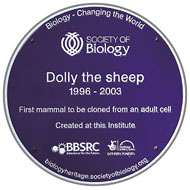
Dolly was created in 1997 by a team of scientists at the Roslin Institute.
A plaque will be unveiled this week to celebrate the team who created Dolly the sheep - the first clone of an adult mammal.
The plaque is one of 10 to be unveiled around the country in a drive to celebrate unsung heroes and inspire a new generation of biologists.
Dolly was created in 1997 by a team of scientists at the Roslin Institute. Lead researcher Sir Ian Wilmut from the University of Edinburgh says the project "revolutionised our understanding of the mechanisms that regulate development."
It was previously believed that a cell could not be changed once it had differentiated to a specific tissue type. "The birth of Dolly showed that this is not the case," he added. "This result stimulated research which is now providing revolutionary opportunities in medicine."
The plaque celebrating Dolly and the team will be unveiled by the Society of Biology at the Roslin Institute.
As part of the society's national project - Biology: Changing the World - a further nine plaques will be unveiled. They will honour unsung biologists including Dorothy Hodgkin from Suffolk, who discovered the structure of penicillin; Steptoe, Edwards and Purdy from Oldham, who pioneered IVF treatment; and Richard Owen from Lancaster who invented the word "dinosaur".
Biologists contribute to our understanding of the world, but do not always receive the same recognition as other great figures in history. The Society of Biology is hoping to change this with its national project.
As well as giving these biologists the commendation they deserve, chief executive Dr Mark Downs says the project is also about celebrating biology and biologists today.
"The life sciences will be essential for solving the problems of the 21st century such as food security and antibiotic resistance," he explained. "By highlighting our great biology heritage we hope to inspire the next generation."
Alongside a public engagement programme, the society has also launched a new free app. By detecting the user's location, the app allows them to learn about great biologists who lived and worked in the area and the discoveries they made.


 Companies marketing medicines for small pets exempt from authorisation must submit their annual return to the Veterinary Medicines Directorate (VMD) by 30 November 2026.



