


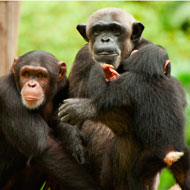
Ever wondered what a chimpanzee's hand signals actually mean?
More than 60 gestures used by chimpanzees in the wild have been decoded for the first time, revealing what they are trying to say when they communicate with body and hand movements.
Scientists at the University of St Andrews in Scotland carried out research to interpret their behaviour by observing over 80 wild chimpanzees in the Budongo rainforest in Uganda to compile a "dictionary" of meaning behind gestures such as arm raises, ground slaps and foot stomps.
The work, carried out by St Andrews primatologists Dr Catherine Hobaiter and Professor Richard Byrne, enhances the long-held belief that our closest living relatives have a purpose when they communicate with each other.
Professor Byrne, explained: "There is abundant evidence that chimpanzees and other apes gesture with purpose. Apes target their gestures to particular individuals, choosing appropriate gestures according to whether the other is looking or not; they stop gesturing when they get the result they want; and otherwise they keep going, trying out alternative gestures or other tactics altogether.
"It has been known for over 30 years that chimpanzees communicate in this way, but oddly enough nobody has attempted to answer the obvious question, what are these apes actually trying to ‘say’?"
Using video to record communicative interactions, the researchers extracted over 4500 instances of gesturing, looking specifically at non-playful uses as in play gestures may not be used with their "real" meaning.
They identified specific meanings for most of the chimpanzee repertoire of 66 gestures, including discovering that when a chimpanzee taps another it means "stop that"; a hand fling or slapping an object means "move away"; while an arm raise means "I want that" or "give me that".
Dr Hobaiter explained: "Just as with human words, some gestures have several senses, but importantly the meanings of chimpanzee gestures are the same irrespective of who uses them. Chimpanzees may use more than one gesture for the same purpose - especially in social negotiations, where the final outcome may be a matter of some give and take.
"Now that the basic chimpanzee gesture ‘dictionary’ is known, we can start to tackle other interesting questions. Do some gestures have very general meanings, where their intended sense is understood from the context? Or do subtle variations in how a gesture is made determine which sense was meant?"
The paper, 'The meanings of chimpanzee gestures' has been published by Current Biology and is available online at: http://dx.doi.org/10.1016/j.cub.2014.05.066


 Companies marketing medicines for small pets exempt from authorisation must submit their annual return to the Veterinary Medicines Directorate (VMD) by 30 November 2026.



