
Your data on MRCVSonline
The nature of the services provided by Vision Media means that we might obtain certain information about you.
Please read our Data Protection and Privacy Policy for details.

In addition, (with your consent) some parts of our website may store a 'cookie' in your browser for the purposes of
functionality or performance monitoring.
Click here to manage your settings.
If you would like to forward this story on to a friend, simply fill in the form below and click send.

Your friend's email:
Your email:
Your name:
 
 
Send Cancel

First hard-bodied creatures named Cloudina
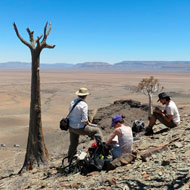
Reef in Namibia
The ancient reef is now located on dry land in Namibia.
Research dates ancient reef to 550 million years ago

A recent study, led by researchers at the University of Edinburgh, has revealed how one of the Earth’s oldest reefs was formed. 
 
The survivor of an ancient aquatic world, the reef is thought to have been built 550 million years ago by what are thought to be the first animals to have had hard shells, and is now located on dry land in Namibia.
 
A process called biomineralisation caused the development of hard, biological structures, allowing animals to fix to each other and to surfaces by producing natural cement.
 
This is thought to be a response to increasing selection pressures, as the reef allowed the tiny creatures to gain access to nutrient rich currents and living space, at a time when resources were scarce. 
 
The filter feeding organisms, known as Cloudina, lived on the seabed during the Ediacaran Period, which ended 541 million years ago. Prior to the emergence of Cloudina, animals had soft bodies.
 
Professor Rachel Wood of the University of Edinburgh’s School of GeoSciences, who led the study, said: “Modern reefs are major centres of biodiversity with sophisticated ecosystems. Animals like corals build reefs to defend against predators and competitors. We have found that animals were building reefs even before the evolution of complex animal life, suggesting that there must have been selective pressures in the Precambrian period that we have yet to understand.”
 
The research has been published in the journal Science, in collaboration with University College London and the Geological Survey of Namibia. It has been supported by the Natural Environment Research Council, University of Edinburgh and the Laidlaw Trust.
 
Image courtesy of Rachel Wood.

 

Become a member or log in to add this story to your CPD history

RCVS announces 1CPD app update

News Story 1
 The RCVS has announced a new version of its 1CPD mobile app, with enhanced features for veterinary surgeons and veterinary nurses to record their continuing professional development.

The mobile app includes a new 'what would you like to do?' shortcut for frequent tasks, a notification badge, and the ability to scan a QR code from the home screen to easily record an activity.

Users will be prompted to update the app from the App Store or Google Play the next time they log in. For more information, visit RCVS.org.uk 

Click here for more...
News Shorts
Nominations open for RCVS and VN Council elections

The nomination period for the 2026 RCVS Council and VN Council elections is now open, with three veterinary surgeon seats and two veterinary nurse seats available.

Prospective candidates can download an information pack and nomination form from the RCVS website. Individuals can nominate themselves for the elections, with the results to be announced in the spring.

Clare Paget, the recently appointed RCVS Registrar and elections returning officer, said: "If you want to play your part in influencing and moulding how the professions are regulated, and making key decisions on matters of great importance to your peers, the public and animal health and welfare, please consider standing for RCVS Council or VN Council next year."

Nominations close at 5pm on Saturday, 31 January 2026.

