


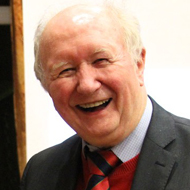
Award for outstanding contribution to the veterinary profession
The first recipient of the RCVS Queen's Medal, said that he feels "humbled and honoured" to win the award.
Des Thompson OBE from Belfast has previously served as president of the RCVS, BSAVA, SPVS and the Northern Ireland Veterinary Association.
He has also been chairman of Veterinary Northern Ireland, a trustee of the RCVS Trust (now RCVS Knowledge) and a council member of the Federation of Veterinarians of Europe.
“To say I was surprised to hear that I had won the Queen’s Medal would be the understatement of the year. I am humbled and honoured that my colleagues should consider me worthy of this prestigious award,” said Mr Thompson.
The RCVS launched the award to celebrate the outstanding contribution of an individual to the veterinary profession.
Mr Thompson was nominated twice – one from John Michael Hill, Chairman of Veterinary Northern Ireland, and the other from Anna Mary Judson, a SPVS council member.
Both nominations cite Mr Thompson’s decades of dedication to the profession and his willingness to help, particularly young graduates at the start of their career, through organisations such as the Young Vet Network in Northern Ireland, for which he serves as a committee member, and the Veterinary Benevolent Fund.
Colonel Neil Smith, President of the RCVS, said: “I am extremely pleased to announce Des Thompson as the first recipient of this very prestigious award.
"What is clear from both of his nominations is the respect and admiration that the veterinary community in Northern Ireland, and beyond, has for him, and his commitment to representing the interests of the profession, as demonstrated by his prodigious number of past-presidencies as well as the number of professional awards he has to his name.
“However, Des’s achievements are also reflected in his wisdom, his kindness and his willingness to support members of the profession from all walks of life.”
The Queen’s Medal will be officially bestowed upon Mr Thompson at the Annual General Meeting of the RCVS on Friday July 11.
Image by Simon Doherty.


 Companies marketing medicines for small pets exempt from authorisation must submit their annual return to the Veterinary Medicines Directorate (VMD) by 30 November 2026.



