


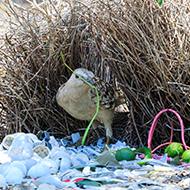
Bowerbirds are using glass and plastic to decorate their nests.
New research has found that male bowerbirds, a species native to Australia and Papua New Guinea, are using human items like plastic and banknotes to win over females.
Bowerbirds are renowned for their unique courtship behaviours. To attract a mate, males build intricate tunnels, or bowers, out of sticks and brightly coloured objects. They then sing and perform complex dance moves to impress visiting females.
While rural birds typically use leaves, fruit, and seeds to add colour to their bowers, a new study by the University of Exeter has found that city birds are adapting to their urban environments.
Researchers compared items collected by bowerbirds in Townsville City and a rural area, both in Queensland, Australia. They found that city birds gathered larger, more colourful decorations than rural birds did, with the most common items being green glass and gold wire.
Study author Dr Laura Kelley said the findings serve as a “reminder of how human activity is changing the natural world in unanticipated ways,” adding, “We don’t yet know whether this has any negative or positive impact on them”.
Caitlin Evans from the Centre for Ecology and Conservation at the University of Exeter explained the mating ritual:
“Bowers are built exclusively to attract a mate, and males choose decorations that contrast against their own plumage and the bower itself. Once a female arrives and stands in the bower, males throw an object into their view and then display the plumage on the back of their head, then throw another object – and so on.
She added: “Our findings show that bowerbirds in a city use a wide range of items scavenged from humans. Glass, plastic and wire were common choices, but we also found items including a pair of handcuffs, medicine jars at bowers near a hospital, and fluorescent mouth guards from a site near an Australian Rules football ground.”
The study, Urbanisation alters courtship signals in male great bowerbirds, is published in Royal Society Open Science.
Image (C) Imogen Warren/Shutterstock.com


 Defra has published guidance for the vet sector ahead of a proposed UK-EU Sanitary and Phytosanitary agreement.



