Your data on MRCVSonline
The nature of the services provided by Vision Media means that we might obtain certain information about you.
Please read our Data Protection and Privacy Policy for details.

In addition, (with your consent) some parts of our website may store a 'cookie' in your browser for the purposes of
functionality or performance monitoring.
Click here to manage your settings.
If you would like to forward this story on to a friend, simply fill in the form below and click send.

Your friend's email:
Your email:
Your name:
 
 
Send Cancel

Study highlights circulation of antibiotic resistance in agriculture
Tests on samples of E.coli bacteria from poultry, farm workers and the surrounding community revealed high levels of resistance to the commonly used antibiotic, cotrimoxazole. 

The findings reinforce the importance of a One Health approach

Researchers at The Roslin Institute have identified a link between high antibiotic resistance and poultry farming in Malawi.

The discovery, described in PLOS Public Global Health, highlights the need for targeted stewardship and a One Health response. 

In the study, Roslin Institute researchers joined forces with fellows from the Fleming Fund - an initiative that aims to improve antimicrobial surveillance, raise public awareness and promote responsible antibiotic use in low-and middle-income countries.

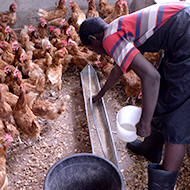
Tests on samples of E.coli bacteria from poultry, farm workers and the surrounding community revealed high levels of resistance to the commonly used antibiotic, cotrimoxazole. This resistance was across animals, humans and the environment, suggesting that resistance is circulating between them.

Conversely, resistance to ceftriaxone - a drug used in hospitals - remained relatively low, highlighting the importance of protecting the drug’s effectiveness.

The study also found that the use of commercial feed, keeping chickens in enclosed spaces and prior antibiotic use were linked to higher levels of antimicrobial resistance. Some farmers were administering antibiotics intended for humans to poultry. 

The findings were presented to the Monitoring, Evaluation, Research and Surveillance Technical Working Group of Malawi’s Ministry of Health and Sanitation. Researchers will now work with the country’s Antimicrobial Resistance National Coordinating Centre to translate the findings into practical steps.

“These findings reinforce the importance of a One Health approach to tackling antibiotic resistance,” commented Dr Stella Mazeri, of the Roslin Institute, and former Fleming Fund Deputy-Director.

“It was a privilege to support the Phase 1 Malawi Fellows in their collaborative project, contributing to evidence that can help guide more effective and context-specific interventions.”

Image (C) Akindele Aremu-cole/Shutterstock

Become a member or log in to add this story to your CPD history

Equine Disease Surveillance report released for Q4 2025

News Story 1
 The latest Equine Disease Surveillance report has been released, with details on equine disease from Q4 of 2025.

The report, produced by Equine Infectious Disease Surveillance, includes advice on rule changes for equine influenza vaccination.

Statistics and maps detail recent outbreaks of equine herpes virus, equine influenza, equine strangles and equine grass sickness. A series of laboratory reports provides data on virology, bacteriology, parasitology and toxicosis.

This issue also features a case study of orthoflavivus-associated neurological disease in a horse in the UK. 

Click here for more...
News Shorts
BSAVA announces 12th Edition of the Small Animal Formulary

The BSAVA has published an updated edition of its Small Animal Formulary, which includes new drug monographs and emergency drug doses for rabbits, rodents, birds and reptiles.

One of BSAVA's most trusted and widely used clinical resources, this 12th edition of the manual also includes seven new client information leaflets and information on drugs used for the management of urinary incontinence.

Part A of the Formulary, Canine and Feline, sees Fergus Allerton return as Editor-in-Chief, while Part B: Exotic Pets was edited by Joanna Hedley. For more information, visit the BSAVA website.