


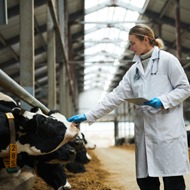
The approach can make a significant difference in herd management.
Vets and farmers are being urged to work together to incorporate blood testing into annual cattle health plans.
The call comes from Linda Morgan of Marches Farm Vets, an independent practice working across Herefordshire, Shropshire and Worcestershire.
Ms Morgan believes that by collaborating with their vet, farmers can gain valuable insights into the health of their herd, identify trace element deficiencies early and make more informed decisions on nutrition and supplementation ahead of turnout.
She said: “As a vet, you can’t advise properly if you don’t know what the animal’s current status is – just because there isn’t obvious disease doesn’t mean everything’s fine.
“Low trace elements and deficiencies can impact fertility, productivity and disease resistance, causing underlying clinical and subclinical problems. The most straightforward way to establish a baseline is a blood sample, and that can often be incorporated as part of the Animal Health and Welfare Pathway, a government-funded advisory scheme available to farmers.
“It’s important to view blood testing as part of a proactive health plan – once you know what you’re working with, you can adjust treatment and target supplementation, investing where it matters most, rather than supplementing for the sake of it.”
One farmer who has already benefitted from this approach is Nigel Lloyd from Shropshire.
Mr Lloyd said: “I saw that some of my cattle weren’t getting into calf, and I know this region is generally thought to be selenium and iodine deficient.
“I wanted to understand what was going on and get a baseline rather than supplementing blindly, so I spoke to Linda, who advised doing blood tests at scanning to check for common deficiencies.
“The results confirmed copper and selenium deficiencies across the cows and the bull, and Linda recommended bolusing as the most reliable and practical way to correct this within our grass-based system and ahead of calving.”
Mr Lloyd believes that working collaboratively with his vet, and incorporating blood testing into his health plan, has made a significant difference in herd management.
He added: “I’d definitely recommend other farmers to work with their vet and do the same, it's a straightforward, preventative step and it’s better than just hoping for the best.”
Image (C) Shutterstock/Pressmaster.

 The latest



