


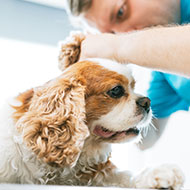
The clinic is delivered by a board-certified neurologist.
The RVC has launched a new hearing clinic at the Queen Mother Hospital for Animals (QMHA).
Established by its Neurology and Neurosurgery Service, the clinic offers hearing tests for litters of puppies and kittens, as well as investigations into hearing loss in adult dogs and cats.
The clinic is delivered by a board-certified neurologist, supported by the RVC’s expert neurology nurses. Referrals can be made by the client’s regular vet.
To assess hearing, the team uses a non-invasive tool known as the Brainstem Auditory Evoked Response (BAER).
Click sounds are played through headphones placed over the animal’s ears, while five small needle electrodes detect any subsequent electrical signal as the sound information is carried along the hearing pathways.
Dr Abbe Crawford, lecturer in neurology and neurosurgery at the RVC, said: “We are excited to be offering a hearing clinic at the QMHA, which will encompass deafness screening for puppies as well as deafness investigations in adult dogs. By screening puppies for deafness, we can support their early care whilst also, importantly, helping breeders to reduce the incidence of congenital deafness in breeds known to be at risk.
“For adult dogs, in which there is a cause for hearing compromise, we can confirm the presence and severity of that compromise, before then undertaking thorough investigations to try to identify the underlying cause.”
Dr Crawford added: “The hearing clinic also offers exciting learning opportunities for our undergraduate and postgraduate students. They will gain exposure to this rapid, non-invasive, patient-side testing, as well as clinical insights to support their understanding of the auditory system and the diseases that can affect it.”
Image (C) Shutterstock/24K-Production.


 Eligible members of BEVA will be able to vote for their Council team until Monday, 17 August 2026. Members will have received an election email on 17 July.



