Your data on MRCVSonline
The nature of the services provided by Vision Media means that we might obtain certain information about you.
Please read our Data Protection and Privacy Policy for details.

In addition, (with your consent) some parts of our website may store a 'cookie' in your browser for the purposes of
functionality or performance monitoring.
Click here to manage your settings.
If you would like to forward this story on to a friend, simply fill in the form below and click send.

Your friend's email:
Your email:
Your name:
 
 
Send Cancel

Feline tumours share genetic similarities with human cancers
"By comparing cancer genomics across different species, we gain a greater understanding of what causes cancer" - Bailey Francis, Wellcome Sanger Institute.

The discovery could lead to new ways to prevent and treat the disease.

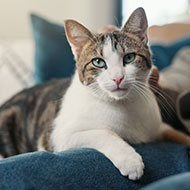
The genetic changes that drive cancer development in domestic cats are comparable to those seen in humans, according to new research. 

The multi-institutional study analysed different tumour types from almost 500 pet cats across five countries and found that certain genetic changes commonly seen in feline cancers mirror those that drive human malignancies. 

For example, the researchers identified that the most common driver gene of feline mammary cancer is similar to the primary driver of human breast cancer, suggesting there are important parallels between the two species. 

It is the first time feline cancer tumours have been profiled at this scale. The work has now been compiled into a freely available resource intended to support future research into feline cancer genomics.

The study was conducted by the Wellcome Sanger Institute, the Ontario Veterinary College in Canada, the University of Bern, and the Cornell University College of Veterinary Medicine. 

Bailey Francis, co-first author at the Wellcome Sanger Institute, said: “By comparing cancer genomics across different species, we gain a greater understanding of what causes cancer. 

“One of our major findings was that the genetic changes in cat cancer are similar to some that are seen in humans and dogs. This could help experts in the veterinary field as well as those studying cancer in humans, showing that when knowledge and data flow between disciplines, we can all benefit.”

Professor Geoffrey Wood, co-senior author at the Ontario Veterinary College, Canada, added: “Despite domestic cats being common pets, there was very little known about the genetics of cancer in these animals until now. 

“Our household pets share the same spaces as us, meaning that they are also exposed to the same environmental factors that we are. This can help us understand more about why cancer develops in cats and humans, how the world around us influences cancer risk, and possibly find new ways to prevent and treat it."

The study, The oncogenome of the domestic cat, is published in Science.

Image (C) Shutterstock/PeopleImages.

Become a member or log in to add this story to your CPD history

Equine Disease Surveillance report released for Q4 2025

News Story 1
 The latest Equine Disease Surveillance report has been released, with details on equine disease from Q4 of 2025.

The report, produced by Equine Infectious Disease Surveillance, includes advice on rule changes for equine influenza vaccination.

Statistics and maps detail recent outbreaks of equine herpes virus, equine influenza, equine strangles and equine grass sickness. A series of laboratory reports provides data on virology, bacteriology, parasitology and toxicosis.

This issue also features a case study of orthoflavivus-associated neurological disease in a horse in the UK. 

Click here for more...
News Shorts
RCVS members invited to question Council candidates

RCVS members have been invited to submit questions to candidates for this year's RCVS Council election.

With 15 candidates standing for three available positions, vets have been invited to submit a question of their choosing before voting starts. These questions will be collated, with each candidate answering one question of their choice.

It is recommended that members read the candidates' biographies and statements before submitting questions. One question per member can be submitted to vetvote26@rcvs.org.uk before Wednesday, 25 February 2026.

The RCVS Council election is due to start in March.

With only two candidates for two positions on the VN Council, there will be no VN Council elections this year. Meghan Conroy RVN and Lauren Hargrave RVN will begin their three year terms at RCVS' AGM in July.