


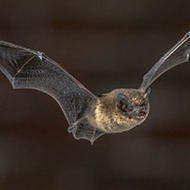
Echolocating bats rely on ‘acoustic flow’ for speed control.
New research has revealed how bats navigate complex environments in complete darkness.
It's commonly understood that bats use echolocation to map their surroundings while hunting at night. But scientists have long been mystified by how they process thousands of overlapping echoes in real time when navigating challenging environments.
To investigate further, a team of aerospace engineers and biologists built a custom 'Bat Accelerator Machine' to test the theory that bats exploit 'autistic flow velocity' to find their way.
Lead author Dr Athia Haron, from Bristol’s School of Civil, Aerospace and Design Engineering, explained: “Bats have a remarkable sensory system, which allows them to interpret echoes from their own calls as they bounce off nearby objects, but how they manage to navigate complex habitats filled with many different obstacles and pinpoint prey with such precision has only now begun to be understood.
“A single bat call will return echoes from multiple objects in different directions and distances. For them to analyse each individual echo becomes too difficult, so they rely on alternative navigational strategies.”
Marc Holderied, Professor of Sensory Biology at Bristol’s School of Biological Sciences, added: “As bats fly and emit their calls, echoes return at slightly different rates depending on how close objects are and how fast the bat is flying.
"This creates a kind of sound flow. This concept is similar to how things seem to rush past your eyes faster when you pick up speed on a bike. By sensing changes in this sound flow, bats can map their surroundings and judge their speed, allowing them to move with remarkable precision.”
The bat accelerator machine comprised an eight metre flight corridor of revolving hedge-like panels lined with 8,000 acoustic reflectors - or artificial leaves - designed to mimic the natural echoes of a real hedge.
The team recorded 181 pipistrelle bat flight trajectories over three nights. Of these, they analysed 104 bats that went through the machine for at least the full eight metres of the test section.
They manipulated the reflectors to alter the acoustic flow speed bats would normally experience during flight, and measured how bats adjusted their flight speed in response to acoustic-flow speed.
These adjustments indicate that bats are sensitive to changes in Doppler shift, a key feature of acoustic flow, and may rely on it to control their speed. It suggests that bats use Doppler-based acoustic flow for navigation, a principle that could inspire new methods for navigation in drone technology.
Study co-author Dr Shane Windsor, from Bristol’s School of Civil, Aerospace and Design Engineering, said: “We know bats fly swiftly, but we’ve shown that we can make them fly even faster with our corridor of ‘revolving hedges’— our bat accelerator. This experiment suggests that echolocating bats rely on ‘acoustic flow’ for speed control and provides evidence that bats may use this mechanism for navigation.”
The study is published in Proceedings B.
Image (C) Rudmer Zwerver/Shutterstock.com


 Two independent vets have launched a podcast to help owners strengthen their bond with pets. Dr Maggie Roberts and Dr Vanessa Howie, who have worked in both veterinary practice and major charities, are keen to use their experience to enable people to give pets a better life.



