


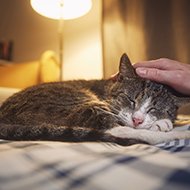
Researchers have described the finding as ‘the perfect natural model for Alzheimer’s’.
New research suggests cats develop dementia in a similar way to people with Alzheimer’s disease.
The study by the University Edinburgh discovered a build-up of the toxic protein amyloid-beta in the brains of cats with the condition — one of the defining features of Alzheimer’s disease.
Experts say their findings reveal how amyloid-beta could lead to age-related brain dysfunction and memory loss in cats.
Study lead Dr Robert McGeachan, from the University of Edinburgh’s Royal (Dick) School of Veterinary Studies, said: “Dementia is a devastating disease - whether it affects humans, cats, or dogs. Our findings highlight the striking similarities between feline dementia and Alzheimer’s disease in people.
“This opens the door to exploring whether promising new treatments for human Alzheimer’s disease could also help our ageing pets. Because cats naturally develop these brain changes, they may also offer a more accurate model of the disease than traditional laboratory animals, ultimately benefiting both species and their caregivers.”
In the study, scientists examined the brains of 25 cats of different ages who had passed away, including some that had signs of dementia. Powerful microscopic imaged revealed a build-up of amyloid-beta within the synapses of older cats and cats with dementia.
Until now, the study of Alzheimers disease has largely relied on genetically-modified rodent models, who do not naturally develop dementia. Scientists say studying cats with dementia could help advance knowledge and aid in the development of treatments for both cats and humans.
Professor Danièlle Gunn-Moore, personal chair of feline medicine at the Royal (Dick) School of Veterinary Studies, said: “Feline dementia is so distressing for the cat and for its person. It is by undertaking studies like this that we will understand how best to treat them.
“This will be wonderful for the cats, their owners, people with Alzheimer’s and their loved ones. Feline dementia is the perfect natural model for Alzheimer’s, everyone benefits.”
The study, Amyloid-Beta Pathology Increases Synaptic Engulfment by Glia in Feline Cognitive Dysfunction Syndrome: A Naturally Occurring Model of Alzheimer's Disease, is published in the European Journal of Neuroscience.
Image (C) Shutterstock.


 Eligible members of BEVA will be able to vote for their Council team until Monday, 17 August 2026. Members will have received an election email on 17 July.



