


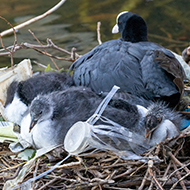
Chicks dying after becoming entangled in plastic materials.
New research led by the University of East Anglia has revealed the extent to which discarded plastic materials are harming birds.
Scientists spent four years monitoring and photographing 32 white stork colonies and nests in Alentejo and the Algarve, southern Portugal.
Their findings, published in the journal Ecological Indicators, reveal that human-derived materials were present in 91 per cent of the 568 stork nests monitored.
Over the course of a year, 35 nestlings (12%) became entangled, with many of those dying due to injuries, such as limb loss and necrosis.
Soft plastics were the most common material, found in 65 per cent of the nests, followed by synthetic ropes, the main cause of entanglement (42%). Baler twine, a slow degrading polypropylene rope used in agriculture, accounted for 63 per cent of the entanglements.
In light of their findings, scientists are warning that the entanglement of white storks underscores a broader environmental issue not limited to that species or Portugal.
Lead author Ursula Heinze said: “Our findings offer new insights into the extent of nestling deaths caused by entanglement, and highlights the urgent need to remove and replace hazardous materials such as polypropylene baler twine from both agricultural use and the environment, given its harmful impacts on nestlings.
“This study suggests that the threat posed by human-derived materials to terrestrial birds may be far more severe than previously recognised.”
Co-author Prof Aldina Franco said: “This is a serious issue. These chicks get entangled in synthetic ropes when they are very young and the ropes slowly strangle their limbs as they grow, mostly legs and feet, leading to necrosis and amputations, they suffer a horrible death.
“Our paper is really timely, it highlights a widespread issue with poorly quantified consequences. In Ukraine, for example, solders are finding nests with fibre optic wires from remote controlled drones. In the UK, several passerines, such as goldfinches and wrens, have also started using different colour polypropylene threads to build their nests. People spotting empty nests at the end of the breeding season may have started to notice this.
She continued: “We show that the impact of plastic in the nests can be underestimated because the negative effects of the ropes and other human-produced materials tend to happen in the early life of the chicks, at an average age of two weeks, and the deaths can go unnoticed.
“Our main goal has been to identify the nesting materials that may pose significant risks to terrestrial bird species and pinpoint their origins, in order to develop effective strategies to mitigate these risks to wildlife.”
Image (C) Shutterstock.


 Two independent vets have launched a podcast to help owners strengthen their bond with pets. Dr Maggie Roberts and Dr Vanessa Howie, who have worked in both veterinary practice and major charities, are keen to use their experience to enable people to give pets a better life.



