


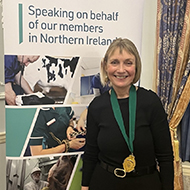
Dr Kirsten Dunbar will help drive efforts to secure an EU-UK agreement.
The newly-announced president of BVA’s Northern Ireland Branch and the North of Ireland Veterinary Association (NIVA) has set out plans to secure future access to veterinary medicines in the country.
Dr Kirsten Dunbar, who steps into the role after a year as junior vice president for both associations, was elected at the joint BVA NI Branch and NIVA Annual General Meeting on Thursday (27 February).
Dr. Dunbar, whose presidential theme is “stronger together”, emphasised the urgent need to resolve the long-standing issue of future access to veterinary medicines in Northern Ireland, as the extended grace period concludes at the end of the year.
She said: “The UK Government's manifesto commitment to secure an EU-UK veterinary agreement presents the best opportunity to achieve a permanent resolution to the issue and we will therefore continue to work with both the Government and the EU to ensure the negotiation is prioritised and the veterinary voice in Northern Ireland is considered.”
Interim proposals
On Monday (3 March), the BVA published two policy positions — one outlining what should be included in any EU-UK veterinary agreement and the other proposing solutions and mitigations to secure future veterinary medicines access in Northern Ireland.
The organisation says the current lack of an agreement and the post-Brexit checks on all goods of animal origin has had a ‘considerable impact’ on disease surveillance, data sharing and animal health and welfare. The introduction of health certifications and physical checks has also put 'significant pressure' on the veterinary profession, it said.
A veterinary agreement with the EU is considered to be the best long-term solution to help maintain high standards of biosecurity, animal heath and welfare, as well as reduce the pressure on the veterinary workforce. However, this is unlikely to be secured before the grace period ends in December 2025.
In the interim, BVA has put forward a number of proposals, including re-routing medicines destined for Northern Ireland through the Republic of Ireland, instead of Great Britain, and developing a Special Import Certificate (SIC). The latter would allow Northern Ireland to import vaccines from outside the European Economic Area that are currently used, like the botulism vaccine, but also any products from GB that it may need.
BVA president Elizabeth Mullineaux said: “A veterinary agreement with the EU could have an incredibly positive impact on so many different areas of concern, but in particular, could finally lead to a permanent resolution to the long-standing question of future access to vital veterinary medicines in Northern Ireland.
“Without a solution, there are serious implications not only for animal health and welfare, but also for public health. We urge the Government to recognise the seriousness of the situation, to engage with the veterinary profession, and to carefully consider the solutions and mitigations we have set out to avoid potentially devastating consequences.”
Image (C) BVA.


 Defra has published guidance for the vet sector ahead of a proposed UK-EU Sanitary and Phytosanitary agreement.



