


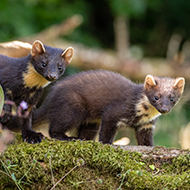
Work is ongoing to restore the missing species in Wales and southwest England.
More than 100 pine martens have been successfully translocated as part of a decade-long project to restore the species across Britain.
The work is a collaboration between Vincent Wildlife Trust (VWT) and Forestry and Land Scotland (FLS) to boost pine marten populations in Wales, Gloucestershire and Devon.
Dr. Jenny MacPherson, principal scientist at VWT, said: “This partnership has been hugely beneficial, not just for pine martens but for the wider conservation landscape.
“Pine martens were once on the brink of extinction in England and Wales because of habitat loss and historical persecution. The concerted effort that has driven this pioneering conservation partnership has re-established and strengthened populations in parts of Britain and helped provide renewed security for these amazing animals.
“The commitment from Forestry and Land Scotland, as well as the support from communities in each region, has been invaluable. This project shows how collaboration can drive tangible conservation successes.”
Since the first translocation of pine martens in Wales in 2015, the re-established populations in Wales and England have increased in numbers and are spreading beyond the initial release sites. Pine martens now live in many counties across Wales and the English border counties, resulting in a ‘resilient western metapopulation’.
Kenny Kortland, wildlife ecologist at FLS, said: “We have a long tradition of conservation work that benefits endangered species in Scotland, and we are happy to help others enhance biodiversity in other parts of Britain. By restoring missing species, we improve the ecological health and resilience of our forests.
“Working in partnership can often be a fundamental element of any ambitious programme like this and reaching the milestone of translocating 100 pine martens in a decade is a fantastic example of what can be achieved through dedicated partnership and science-led conservation.”
Looking ahead, the VWT and FLS aim to help the newly established pine marten population, as well as those in Scotland to increase and expand their range. Plans include ongoing monitoring to ensure the stability of these populations and further community engagement initiatives.
Image (C) Shutterstock.


 Veterinary practices are being urged to help owners safely dispose of any unused and expired pet medicines - not just antibiotics - during November's Animal Medicines Amnesty.



