


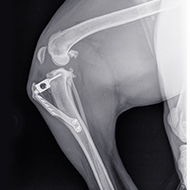
The most commonly performed procedures were osteotomies.
There has been a 79 per cent rise in the number of canine cruciate surgeries recorded by veterinary professionals in the last year, according to a new report.
RCVS Knowledge investigated three years of reports on cruciate surgery outcomes on dogs aged from three months to 18 years. The Registry dataset now contains the details of 1,319 canine cruciate surgical procedures, compared with 725 reported in 2023.
It is hoped the findings will provide valuable data to help veterinary professionals and dog owners make informed clinical decisions.
The RCVS Knowledge Canine Cruciate Registry (CCR) Report 2024 contains data provided by 138 UK-based veterinary professionals. It provides a breakdown of the clinical outcomes of different surgical techniques, patient demographics, use of antibiotics, and more.
According to the report:
- Staffordshire Bull Terriers are no longer among the top five most common breeds on the registry, with Cockapoos jumping from seventh most common to fourth.
- The rest of the top five remained unchanged from 2023: Labrador Retrievers (first), English Springer Spaniels (second) Golden Retrievers (third), and Cocker Spaniels (fifth).
- The most commonly performed procedures were osteotomies, while the proportion of Tibial Plateau Levelling Osteotomy (TPLO) procedures have increased.
- Regional anaesthesia was used in 82.6 per cent of patients. A femoral and sciatic block was the most commonly performed technique,
- Patient weights ranged from 1.6kg to 80.3kg, with the number of patients reported as Overweight and Too Heavy having reduced by 1.5 per cent since the last report.
- Most patients (97.5%) had an intra-articular assessment, a 5.5 per cent increase from 2023. Arthrotomies remain the most common.
- Antibiotics were used peri-operatively for most patients (99.9%), remaining constant with data from 2023.
- Only about a third (36.1%) of patients were dispensed post-operative antibiotics, a reduction of one per cent since 2023.
- Adverse event reporting increased, with haemorrhage remaining the most common. In line with the last report, the majority of patients are still rated ‘Much Better’ at all time intervals post-surgery.
Clinical lead for the Registry Mark Morton said the data will enable vets to look at what they can do to better patient outcomes.
He said: “It has been fantastic to see the CCR go from strength to strength this year with contributions from owners and vets across the country. Evaluating what we do and sharing this information with owners is really important. There is now sufficient data in the registry that vets can use the reporting functionality to see how they compare to anonymous data from the registry as whole.”
Steve Butterworth, veterinary surgeon at Weighbridge Referral Service, Swansea, and CCR contributor, said: “To better understand the long-term outcomes for different breeds of dog using differing surgical techniques we need the power of numbers and this will only be achieved by pooling our resources.
“The CCR offers the veterinary profession an opportunity to do this. Ultimately, doing so might enable us to better inform owners of outcomes following surgery and, potentially, to enhance our ability to customise treatment for each patient.”


 Companies marketing medicines for small pets exempt from authorisation must submit their annual return to the Veterinary Medicines Directorate (VMD) by 30 November 2026.



