


New horse-riding simulator to be unveiled
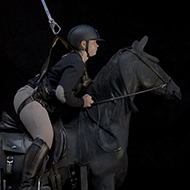
"Beginners can learn how to sit on the saddle during the basic gaits before starting to ride a real horse, whoch reduces injury risk and improves the horse welfare" - Professor Heikke Handroos.
A new horse-riding simulator will be revealed at the Saddle Research Trust's 4th International Conference. The state-of-the-art simulator will improve horse welfare, with beginners able to learn basic gaits before starting to ride.
The simulator, creating using the latest approaches in engineering sciences, has a freely programmable motion capability, and has been designed to provide the necessary motion capabilities for the simulator in all gaits, with jumping included. The technology makes it possible to replicate the motion of real individual horses.
At the conference, Professor Heikki Handroos PhD will give a comprehensive session on the most important outcomes of the Horzim Project, to demonstrate how the engineering science has been utilised to develop the new horse-riding simulator.
Professor Handroos, from the Department of Mechnical Engineering at the Lappeenranta-Lahti University of Technology, said: “This realistic horseback riding simulator can benefit riders with different skills in many ways.
“Beginners can learn how to sit on the saddle during the basic gaits before starting to ride a real horse, which reduces injury risk and improves the horse welfare.
“The simulator can also carry heavier riders to help them to access the hobby with reduced welfare risks. For more advanced riders the technology will enable them to practice and enhance their skills as often as they wish.”
Not only does the simulator have the potential to improve the welfare of ridden horses, but it also has potential as a hippotherapy tool.
Professor Handroos explains: “It has the potential to enable the ideal gait pattern to be programmed for each patient.
“We should also be able to use sensors to monitor the rider, while the simulator is performing different gait patterns.
“The same sensor technology could also be used in riding schools to monitor the learning curves of riding students.
“Our next project is going to be on sensing the rider’s bio-signals when riding the simulator and intelligent processing of sensor data to assess the progress of riding school students or hippotherapy patients.”
Taking place on Saturday 11 December, the Saddle Research Trust Conference will focus on the 'Welfare and Performance of the Ridden Horse: The Future'. Tickers are available here.


 Companies marketing medicines for small pets exempt from authorisation must submit their annual return to the Veterinary Medicines Directorate (VMD) by 30 November 2026.



