


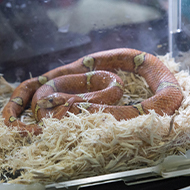
Animal welfare campaigners call for new legislation on enclosure size.
The minimum enclosure size for snakes should enable them to stretch out fully in all directions, leading experts say.
A scientific review of snake enclosure recommendations, published in Animals, also found that current information on enclosure size is based on 'decades-old ‘rule of thumb’ practices' that are 'unsupported by scientific evidence'.
“Snakes are sentient, intelligent, and physically delicate wild animals that all too often spend almost their entire lives imprisoned in a glass tank the size of a hat box while being gawped at like living curios,” commented study author Dr Clifford Warwick of the Emergent Disease Foundation.
“Our article exposes the nonsense that has led to decades of snake abuse, and that the UK now lags behind even the American pet trade where snake welfare is concerned.”
According to the Animal Protection Agency (APA), around 42 per cent of private snake owners house their animals in enclosures that are too small. Furthermore, snake breeders often keep their animals in ‘racks’, which are essentially plastic drawers designed to simplify maintenance.
‘Such restrictive confinement can lead to serious infections, injuries and disease as well as mental and behavioural problems,’ the APA writes. ‘Small enclosures also make it impossible to regulate temperature, lighting and humidity or to provide enrichment in the form of hides, branches or pools.’
Under current government guidelines, snakes in pet shops must be housed in enclosures sized at two-thirds of the snake’s body length. The study authors found that the original evidence for these recommendations can be traced back to two books based on common practices and personal opinion.
APA director Elaine Toland said the review puts to bed any argument that snake welfare is not compromised by small enclosures.
“A legal requirement for enclosure sizes that allow snakes to adopt straight-line postures in all directions, as an absolute minimum, would at least allow snakes to perform some of their normal behaviours,” she said. “This is still far from ideal, but animal welfare legislation needs to be urgently updated in order to reflect the complex needs of reptiles.”


 Veterinary practices are being urged to help owners safely dispose of any unused and expired pet medicines - not just antibiotics - during November's Animal Medicines Amnesty.



