


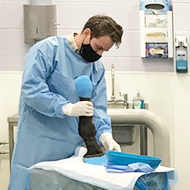
In-person CPD courses will run alongside digital lessons
BEVA’s popular CPD courses are set to resume this month, with face-to-face lessons running alongside digital learning.
After more than a year of COVID-enforced online CPD, members and non-members will soon be able to take advantage of a wide array of hands-on, in-person courses, including the BEVA fundamentals series.
Together with the practical learning, there will also be a series of online courses with new content being added regularly.
A BEVA spokesperson said: "Strict COVID safety precautions are in force for each course; pre-course lateral flow tests are compulsory for all attendees, numbers are strictly limited, facemasks are required and hand sanitation sites are available."
A list of the available courses is below. For more information and to sign up, visit beva.org.uk/CPD1
Upcoming practical courses
- fundamentals of lameness, laminitis and farriery, 20 May
- fundamentals of radiography and ultrasound 6 June
- BEVA Approved: BARTA veterinary responder course, 14 June
- pre-purchase examination – the essentials, 6 July
- the equine back, 10 July
- fundamentals of the skin, eyes, medicines and difficult moments, 21 July
- fundamentals of sedation, field anaesthesia and castration, 15 September
- event incident management, 30 September
- fundamentals of equine emergencies, 6 October
- pre-purchase examination – the essentials, 18 October
- foot and farriery, 8 November
- fundamentals of gastroenterology, 11 November
- interactive cardiology workshop, 11 November
- fundamentals of dentistry, 20 November
- dentistry – the next steps, 21 November
- equine ophthalmology, 29 November.
- from superfoods to supplements: how to know more than the owner, 7 July
- advanced theoretical equine dental technicians course, 19 August
- advanced theoretical equine dental technicians course – online discussion only in preparation for the BEVA/BVDA examination, 19 August
- advanced imaging discussion forum, 14 October
- advanced reproduction discussion forum, 1 December.


 Veterinary practices are being urged to help owners safely dispose of any unused and expired pet medicines - not just antibiotics - during November's Animal Medicines Amnesty.



