


Cats twice as likely to survive snakebites than dogs
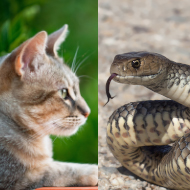
Cats in the study were twice as likely to survive being bitten by a snake than dogs.
Researchers at the University of Queensland have discovered that cats are twice as likely to survive a venomous snakebite than dogs.
In a study published in Comparative Biochemistry and Physiology, scientists compared the effects of different snake venoms on the blood clotting agents in cats and dogs.
They found that while only 32 per cent of dogs can survive being bitten by an eastern brown snake without antivenom, cats were twice as likely to survive at 66 per cent.
Even with antivenom treatment, cats have a significantly higher survival rate, but until now the reasons for this were unknown.
Using a coagulation analyser, researchers tested the effects of eastern brown snake venom, in addition to 10 additional venoms found around the world, on dog and cat plasma in the lab.
They found that all venoms acted faster on dog plasma than cat or human, suggesting that dogs would likely enter a state where blood clotting fails sooner, and are therefore more vulnerable to these snake venoms.
“The spontaneous clotting time of the blood – even without venom – was dramatically faster in dogs than in cats,” said lead author Professor Bryan Fry. “This suggests that the naturally faster clotting blood of dogs makes them more vulnerable to these types of snake venoms.”
Snakebite is a common occurrence for pet owners across the world and it can be fatal. This is in part due to a condition called ‘venom-induced consumptive coagulopathy', where an animal loses its ability to clot blood and sadly bleeds to death.
In Australia alone, the eastern brown snake alone is responsible for an estimated 76 per cent of reported domestic pet snakebites each year.
The researchers hope their insights can lead to a better awareness of the critically short time window to get treatment for dogs envenomed by snakes.
“As dog lovers ourselves, this study strikes close to home but it also has global implications,” said Dr Fry. “I’ve had two friends lose big dogs to snakebites, dying in less than ten minutes even though the eastern brown snakes responsible were not particularly large specimens.
“This underscores how devastatingly fast and fatal snake venom can be to dogs.”


 Veterinary practices are being urged to help owners safely dispose of any unused and expired pet medicines - not just antibiotics - during November's Animal Medicines Amnesty.



