


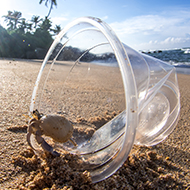
Plastic debris is creating physical barriers and deadly traps
More than half a million hermit crabs have been killed after becoming trapped in plastic debris, according to new research.
The study involving scientists at the University of Tasmania revealed that over 560,000 hermit crabs have been killed on the Cocos Islands in the Indian Ocean and the Henderson Islands in the Pacific.
Published in the Journal of Hazardous Materials, the study built on previous research which revealed that the islands are littered with millions of pieces of plastic. Researchers say the plastic is creating physical barriers and a series of traps that are potentially deadly for the crabs.
Dr Jennifer Lavers from the Institute for Marine and Antarctic Studies said that while much attention has been given to plastic in oceans, little research has been conducted into the risk that marine pollution poses to wildlife.
“When we were surveying debris on the islands, I was struck by how many open plastic containers contained hermit crabs, both dead and alive,” Dr Lavers said. “These results are shocking but perhaps not surprising, because beaches and the vegetation that fringes them are frequented by a wide range of wildlife.
“It is inevitable that these creatures will interact with and be affected by plastic pollution, although ours is one of the first studies to provide quantitative data on such impacts.”
Dr Lavers added that marine pollution is a global problem, and that equivalent hermit crab deaths on a worldwide scale would have important implications for the ecosystem.
“Hermit crabs play a crucial role in the health of tropical environments by aerating and fertilising soil, and dispersing seeds and removing detritus, as well being a key part of the marine ecosystem,” she continued.
“Their population degradation is more than just a risk to the natural environment. They are also an important part of marine ecosystems that humans rely on for fishing, recreation and tourism, so ultimately the impacts may also be economic.
“Our study is the first to document the mortality of hermit crabs due to beach debris, but the broader global picture remains unknown. However, it is likely that the mortality of hermit crabs across the world’s beaches is substantial, and further investigation is required to inform a broader understanding of the scale and implications of their loss.”


 Veterinary practices are being urged to help owners safely dispose of any unused and expired pet medicines - not just antibiotics - during November's Animal Medicines Amnesty.



