
Your data on MRCVSonline
The nature of the services provided by Vision Media means that we might obtain certain information about you.
Please read our Data Protection and Privacy Policy for details.

In addition, (with your consent) some parts of our website may store a 'cookie' in your browser for the purposes of
functionality or performance monitoring.
Click here to manage your settings.
If you would like to forward this story on to a friend, simply fill in the form below and click send.

Your friend's email:
Your email:
Your name:
 
 
Send Cancel

Exotics vets treat 61-year-old tortoise for bladder stones
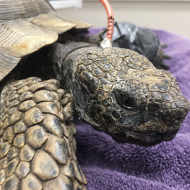
Mohave was referred to the exotics team at UC Davis Veterinary Hospital.

Team removed stones without having to cut through the shell

Exotics vets in the US are reiterating the importance of annual check-ups after successfully treating a 61-year-old tortoise for a recurrence of bladder stones.


Desert tortoise Mohave was presented to the UC Davis Veterinary Hospital after his caretakers noticed that his urates had become thick and pasty. He subsequently suffered a cloacal prolapse, most likely caused by straining to eliminate the pasty urates.

Veterinary surgeon Juliana Sorem from Wildcare - a wildlife hospital and Mohave’s home since 2003 - took radiographs and noticed some distinct white shapes within his abdomen.

“We compared the images with the radiographs taken at his last routine physical and didn’t see these objects on them,” she said. “Given his clinical signs and the radiographic images, I was fairly certain the stones had recurred.”


Mohave was referred to the exotics team at UC Davis Veterinary Hospital, who had successfully removed bladder stones from Mohave in the past, without having to cut into his shell.

Faculty member Dr David Guzman and resident Dr Sarah Ozawa were able to remove the stones via an endoscopic-assisted procedure - a minimally invasive technique that allows clinicians to access the bladder through the prefemoral fossa in front of the hind limb, instead of cutting through the shell.


The team said that owing to Mohave’s regular care and annual check-ups, the stones were caught early enough to be removed in this way. Dr Guzman warns that if stones go unchecked for too long, they can grow so large that it may be complicated or impossible to be removed through a minimally invasive approach.


“If we have to enter through the plastron, it’s very invasive,” said Dr Guzman. “It takes a long time to heal, and sometimes it fails to heal properly. So, Mohave’s case is a great example of the importance of annual check-ups for any animal.”


Mohave’s case is detailed in a study published in the Journal of the American Veterinary Medical Association.

Image (C) UC Davis Veterinary Hospital.

Become a member or log in to add this story to your CPD history

FIVP publishes CMA Compliance Checklist

News Story 1
 FIVP has published a CMA Compliance Checklist to support independent practices with the Market Investigation Order.

The document includes deadlines for small and large businesses, with tick boxes for each of the tasks. The organisation also invites practices to contact them for support with requirements.

Rita Dingwall, FIVP chair, said: FIVP appreciates that navigating the new CMA requirements can feel daunting. We hope this checklist will make things a little easier, helping independent practices work through what is required with confidence. 

Click here for more...
News Shorts
APHA launches free virtual work experience programme

The Animal and Plant Health Agency (APHA), in collaboration with Springpod, has launched a free virtual work experience programme, giving young people across the UK the chance to explore careers dedicated to protecting animal and plant health.

The on-demand programme offers a unique insight into career opportunities within APHA, showcasing how students can contribute to tackling some of the UK's most critical biosecurity and environmental challenges.

Designed for students aged 13 and over, the course includes more than 10 hours of engaging content featuring real-life industry insights, scenario-based challenges, and practical guidance on applying for jobs. To register for the course, visit the APHA website.

