


Parrot performs 16 dance moves, scientists say
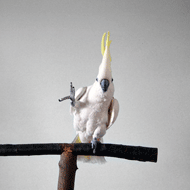
The recent study suggests there are five distinct capacities that form key evolutionary prerequisites for dancing to music. (Stock photo)
A parrot in the US can perform 16 distinct dance moves, some of which he appears to have invented himself, according to a new study.
The research, published in Current Biology, suggests that, like humans, parrots can respond to music using a wide variety of movements and body parts.
Over 10 years ago, researchers at Tufts University studied Snowball, a sulphur-crested cockatoo, bobbing his head to the beat of a Backstreet Boys song. This suggested that parrots, unlike most species, have the cognitive ability to anticipate a beat and move to it.
In the latest study, researchers found that Snowball can perform 16 different dance moves, none of which he has been trained to do. His dancing developed through social interaction with people and he appears to have made up some of the moves, as his owner Irene Schulz, a co-author on the study, does not make these moves when she dances with him.
Tufts researchers say that dancing to music is not just an arbitrary product of human culture.
Psychology professor Aniruddh Patel said: “It’s a response to music that arises when certain cognitive and neural capacities come together in animal brains.”
The recent study suggests there are five distinct capacities that form key evolutionary prerequisites for dancing to music.
“We think this helps explain why so few species - and no other primates - share our impulse to move to music in spontaneous and diverse ways,” he added.
Now the team hope to find out whether parrots - like humans - prefer to dance with another of their kind rather than alone.
Video by Bird Lovers Only Rescue Service
Image (c) Irena Schulz


 Veterinary practices are being urged to help owners safely dispose of any unused and expired pet medicines - not just antibiotics - during November's Animal Medicines Amnesty.



