


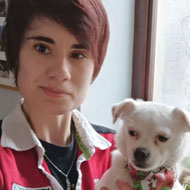
Sessions to help students who feel stressed or suffer from anxiety
A novel pet therapy scheme has been introduced at a college in Wales to re-engage students who might otherwise be at risk of leaving education.
Taking place at Coleg y Cymoedd in collaboration with Time to Change Wales, the scheme’s overall aim is to support students who might be at risk of becoming disengaged with education, training opportunities and future employment.
The sessions will see volunteer Alexandra Osborne attend the College’s four campuses on a monthly basis with her pet therapy dog, Dora. Students will be allowed to sit with Dora, cuddle her and relax.
For learners who feel stressed or suffer from anxiety, just half an hour with Dora helps to calm them and make them feel much better.
The idea to introduce pet therapy came after a talk delivered by Alex at the College about the Time to Change campaign and how her dog had helped her personally. The college asked Alex if she would be interested in running some sessions with students.
Speaking about her personal journey, Alex said: “I find the scheme really rewarding. I know first-hand what it’s like to suffer from issues with mental health and also know just how beneficial therapy dogs can be. My dogs have helped me immensely over the years with my own mental health, so I wanted to help others in the same position.
“Dogs have an amazingly calming effect - just stroking a dog can bring your blood pressure down. It’s amazing to see how the visits are helping the learners. If it means someone stays in college because of Dora, it’s definitely worth it.”
Coleg y Cymoedd principal, Karen Phillips, said: “Our mission is to ensure that every learner has the opportunity to access the very best education to enable them to be successful and progress to university, work or an apprenticeship. Providing the highest level of pastoral care for all learners is a key part of this.
“This includes excellent academic support through an extensive personal tutorial programme, mentoring programmes, educational visits and guest speakers. But, of equal importance is the wellbeing of our learners and the work of our expert learner support teams, who look after the physical and emotional health of learners.
“The introduction of pet therapy on campus is just the latest step we are taking to support our learners to ensure they are able to succeed in accessing the education, training and employment opportunities available to them here.”
Image (C) Time to Change Wales.


 Veterinary practices are being urged to help owners safely dispose of any unused and expired pet medicines - not just antibiotics - during November's Animal Medicines Amnesty.



