


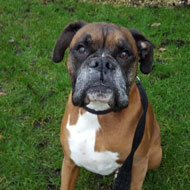
Travis resuscitated three times after his heart stopped during a walk
A professional dog walker put her animal first-aid skills to the test when she saved the life of a boxer dog in her care.
Karen Hodge was walking eight-year-old Travis near Mansfield in December when he slipped and fell down a hill. She first thought that he was fitting, having looked after epileptic dogs before, but then he didn’t seem to recover as expected.
“He lost control of his bowels, and then I saw he’d stopped breathing and his eyes were glazing over,” she explained. “At that point, I knew something was seriously wrong, and I needed to act immediately.”
As luck would have it, Karen had recently completed a PDSA Pet First Aid course - organised by the charity Notts & Yorkshire Boxer Rescue, where she also volunteers.
“The PDSA Pet First Aid course was great, it covered lots of information and we did demos too, so everything was fresh in my mind,” she said. “I never thought I’d be using the skills so soon, but something just took over - I went into automatic and knew exactly what to do.”
Karen confirmed that Travis’ heart had stopped and that he wasn’t breathing, so she began to deliver CPR. She also asked her daughter Emily, who was with her that day, to run back to the van and call Travis’ owners.
Travis came round after several minutes but was confused and unable to walk, so Karen and Emily carried him back to the van and set off for the nearest veterinary practice. During the one-mile journey, Travis stopped breathing again and Karen told her daughter how to carry out CPR whilst she continued to drive - thankfully, he was resuscitated again.
Travis’ heart stopped for the third time on arrival at the vets and needed to be resuscitated by the veterinary team. They were able to stabilise him, but later referred Travis to a specialist cardiologist, where he was diagnosed with dilated cardiomyopathy.
Travis is now on medication for his condition but has been warned against any vigorous exercise as his heart could stop at any time. Owner Julie, who has had Travis since he was a puppy, said: “We really can’t thank Karen enough – without her Travis wouldn’t still be with us.
“Thankfully he’s pretty much back to normal, he still loves to play and to look at him you wouldn’t know anything was wrong with him. But it’s a real worry for us that this could reoccur, it’s like living on tenterhooks constantly.”
PDSA community vet nurse, Kaya Hawrylak, who delivered the Pet First Aid course, said: “Travis is incredibly lucky to be alive, and he has Karen to thank for that. Our Pet First Aid courses enable people to learn vital emergency skills that can literally mean the difference between life and death for pets until they can get to a vet.”
Image (C) PDSA


 Companies marketing medicines for small pets exempt from authorisation must submit their annual return to the Veterinary Medicines Directorate (VMD) by 30 November 2026.



