


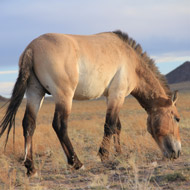
DNA analysis shows Przewalski’s horses have domestic ancestors
The last ‘wild’ horse on earth is a direct descendant of the earliest domestic horse, according to new research.
Until now, it was thought that all modern domestic horses descended from horses that were domesticated at Botai, some 5,500 years ago, and that only one population of wild horses, the Przewalskis, survived. But now a new study published in the journal Science has turned this idea on its head.
In the study, an international team of scientists sequenced the genome of 42 ancient horses, including 20 from Botai, to reveal the biological changes underlying the process of animal domestication. But the researchers were surprised to find that, instead of being the source of modern domestics, the Botai horses appeared to be direct ancestors of Przewalski horses.
“Our findings literally turn current population models of horse origins upside-down,” said says Ludovic Orlando, professor of molecular archaeology at the University of Copenhagen and research director at the CNRS, University of Toulouse. “What we used to understand as the last wild horse on earth is, in fact, the descendant of the earliest domestic horses, which simply escaped human pressure and became feral during the last few millennia.”
The study identified a number of DNA changes that underpin this feralization process, including a variation of the TRPM1 gene involved in leopard spotting. The variation used to be present amongst Botai horses, but it was eliminated from the Przewalski horse’s gene pool.
Researchers say that because such a variant is also linked to night blindness, there is a chance that it could have been maintained artificially by humans and quickly lost by natural selection after the horse turned feral.
“Ironically, we used to think that the endangered population of Przewalski’s horses should be preserved as the last wild horses in the planet,” said Charleen Gaunitz, one of the two PhD students in the Orlando team, who carried out the experimental work for the study. “We now find that they must be preserved as the closest descent of the earliest domestic horses”.
Image (C) University of Veterinary Medicine, Vienna / Ludovic Orlando.


 Eligible members of BEVA will be able to vote for their Council team until Monday, 17 August 2026. Members will have received an election email on 17 July.



