


Horses 'can communicate their preferences with humans'
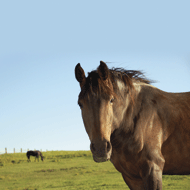
Horses preferred to remain without a blanket in nice weather, but to have a blanket on in wet, windy or cold weather.
A new study suggests horses can learn to communicate with humans by touching different symbols to indicate whether they want a blanket on or off.
Reward based operant conditioning was used to teach a group of horses to approach and touch a board, and to understand symbols on three boards, which indicated either 'no change', 'blanket off' or 'blanket on'.
Scientists from the Norwegian Veterinary Institute found that horses preferred to remain without a blanket in nice weather, but to have a blanket on in wet, windy or cold weather.
When 22 horses were tested on one of two sunny days (20-23ºC) all 10 wearing the blanket touched the 'blanket off' board. The remaining 12 who did not have a blanket on touched the board meaning 'no change'.
The same 22 horses were tested again in colder weather (5-9ºC). In these conditions, all 10 wearing the blanket indicated 'no change' while 10 that were not wearing a blanket touched the 'blanket on' board and the remaining two without a blanket indicated 'no change'. However, the same two gave the 'blanket on' signal on two different test days when temperatures were -12ºC and 1ºC with sleet respectively.
Writing in the journal Applied Animal Behaviour Science, researchers summarised the findings: 'Horses chose to stay without a blanket in nice weather, and they chose to have a blanket on when the weather was wet, windy and cold. This indicates that horses both had an understanding of the consequence of their choice on their own thermal comfort, and that they successfully had learned to communicate their preference by using the symbols.'
The team believe their novel method could pave the way for further research on horse preferences regarding management and training routines.
Read the full study here: http://www.appliedanimalbehaviour.com/article/S0168-1591(16)30219-2/fulltext


 Eligible members of BEVA will be able to vote for their Council team until Monday, 17 August 2026. Members will have received an election email on 17 July.



