


Poultry red mites study receives funding boost
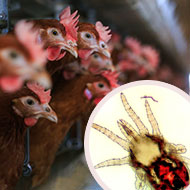
The project has the potential to reduce the number of experimental hens used in poultry red mite colony maintenance.
Researchers at the Moredun Research Institute have been awarded just shy of half a million pounds to develop a novel way of studying poultry red mites.
Poultry red mites are a major economic and animal welfare issue for the international egg industry, and researchers across the globe are working to develop new methods of control. To supply mites for any research programme, however, donor hens must be infested with the parasite to provide sufficient numbers of mites for studies.
Moredun will use the £483,000 grant to establish a laboratory colony of red mites and develop a new feeding method which removes the need to use infested hens. The money was awarded by the National Centre Replacement, Refinement and Reduction of Animals in Research (NC3Rs).
Study co-author, Dr Francesca Nunn, said: “This is an exciting project that not only has the potential to seriously reduce the numbers of experimental hens used in poultry red mite colony maintenance, but also increase our understanding of the feeding behaviour and population dynamics that will be greatly useful in future control strategies against this important parasite.”
Preliminary studies by Moredun found that poultry red mites feed on goose blood through a disposable synthetic skin-like membrane. Researchers say that live geese are particularly suited to be blood donors for this task because they can supply around 30 times more blood than hens in a single donation.
Using this new method, Moredun believes that the number of hens used for the maintenance of poultry red mites could be reduced by as much as 90 per cent per year. Furthermore, by taking away the need for hens to be continuously infested with the parasites, welfare standards will increase.
Dr Alasdair Nisbet, head of vaccine and diagnostic development and principal investigator of the study says: “I’m delighted to be able to continue our work on reducing the numbers of hens used for poultry red mite research and refining our approaches in this area in partnership with the NC3Rs. We look forward to another three years of a high level of impact in these areas.”


 The RCVS has announced a new version of its 1CPD mobile app, with enhanced features for veterinary surgeons and veterinary nurses to record their continuing professional development.



