


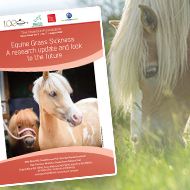
Publication brings together the latest research.
A new booklet highlighting the vital role owners can play in reporting equine grass sickness (EGS) has been published by the Moredun Research Institute.
The booklet, entitled Equine Grass Sickness: A Research Update and Look to the Future, also aims to improve understanding of the incidence and risk factors associated with the disease.
It has been compiled in collaboration with the University of Edinburgh, the EGSF, University of Liverpool, British Horse Society and World Horse Welfare (WHW).
Roly Owers from WHW said “Equine grass sickness is a truly horrible disease that all too often impacts World Horse Welfare directly, with one of our Rescue and Rehoming Centres being in Aberdeenshire and another in Norfolk, both areas with a high EGS prevalence It is a disease that has been known about for decades yet there is still so much we don’t know about it.
“We are pleased to support this publication bringing together the latest information about this pernicious and stubbornly mysterious disease and to work with EGSF in their determination to increase our understanding of it and to find a cure for it.”
Moredun began researching into EGS in the 1920s when the disease caused the deaths of many working horses on farms. One-hundred years later, the disease continues to elude researchers, but the consensus is that it is likely to be caused by numerous factors.
There are no treatments or vaccines to prevent EGS, and around 80 per cent of horses that contract the disease do not survive. It is strongly linked to the east of the UK, with Aberdeenshire being the county suffering the most cases annually in the UK.
EGS also has a seasonal pattern and is most common in the spring, early summer and in young, adult equines.
Helene Mauchlen, from BHS Scotland, commented: “We are delighted to support this research update, which is a useful summary of exactly where we are with this complex and destructive disease, showcasing decades of work and signposting us to a better and hopefully EGS-free future”.


 The RCVS has announced a new version of its 1CPD mobile app, with enhanced features for veterinary surgeons and veterinary nurses to record their continuing professional development.



