
Your data on MRCVSonline
The nature of the services provided by Vision Media means that we might obtain certain information about you.
Please read our Data Protection and Privacy Policy for details.

In addition, (with your consent) some parts of our website may store a 'cookie' in your browser for the purposes of
functionality or performance monitoring.
Click here to manage your settings.
If you would like to forward this story on to a friend, simply fill in the form below and click send.

Your friend's email:
Your email:
Your name:
 
 
Send Cancel

New model to predict effectiveness of livestock vaccines
The study has implications for the design of vaccines and vaccination programmes in livestock.

Researchers use model to study effectiveness of PSSR vaccines 

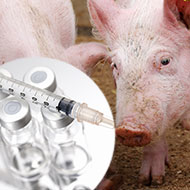
A new model to predict the effectiveness of vaccines in livestock has been developed by scientists at The Roslin Institute.

Researchers found that, when applied appropriately, even imperfect vaccines can prevent, mitigate or eliminate the prevalence of disease.


Scientists say the study has implications for the design of vaccines and vaccination programmes in livestock. Professor Andrea Wilson from the Roslin Institute explains:


“Veterinary vaccines often only confer limited immunity and thus may not prevent infection. In this study, we developed a model that combines epidemiological consequences of different vaccination strategies and different vaccine properties applied to livestock. 


“The model is successful in predicting the effectiveness of vaccines in livestock.”


The overall aim of vaccination is to protect animals from disease and reduce the risk of disease outbreaks. The new model shows that combining diverse vaccine properties could have a multiplicative effect and may, therefore, be more effective. 


In the study, scientists used the model to study the effectiveness of vaccines to combat Porcine Reproductive and Respiratory Syndrome (PRRS) virus.


Endemic in most pig-producing countries, PRRS causes breathing problems and can be fatal in young animals. However, vaccines to prevent the spread of the disease have mostly failed

Scientists believe the new model shows that the control or elimination of PSSR through vaccination may well be in reach, so long as the vaccine speeds up recovery and reduces virus replication.


Become a member or log in to add this story to your CPD history

BSAVA partners with BVA Live 2026

News Story 1
 BSAVA is to partner with BVA Live (11-12 June 2026) to champion clinical research.

The organisation will be supporting BVA Live's Clinical Abstracts programme, showcasing selected abstracts of veterinary research throughout the event.

The clinical abstracts can be on any small animal veterinary subject, and must be based on research undertaken in industry, practice or academia. Abstracts can be presented in poster or oral formats.

Submissions will open on 15th December 2025, and close on 6th March 2026. You can register interest here

Click here for more...
News Shorts
Nominations open for RCVS and VN Council elections

The nomination period for the 2026 RCVS Council and VN Council elections is now open, with three veterinary surgeon seats and two veterinary nurse seats available.

Prospective candidates can download an information pack and nomination form from the RCVS website. Individuals can nominate themselves for the elections, with the results to be announced in the spring.

Clare Paget, the recently appointed RCVS Registrar and elections returning officer, said: "If you want to play your part in influencing and moulding how the professions are regulated, and making key decisions on matters of great importance to your peers, the public and animal health and welfare, please consider standing for RCVS Council or VN Council next year."

Nominations close at 5pm on Saturday, 31 January 2026.
