


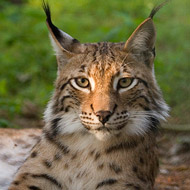
Association believes lynx pose a 'real threat' to British livestock
Further to the announcement that wild lynx could be introduced to parts of the UK, the National Sheep Association (NSA) has contacted Natural England and a leading UK peer to voice its opposition.
The NSA believes reintroducing lynx after more than 1,300 years of extinction will pose a real threat to British livestock. They say that even trial work with the wild cat could lead to the predation of livestock - particularly lambs and ewes.
NSA chief executive Phil Stocker has written to James Cross, head at Natural England, and Lord De Mauley, parliamentary under-secretary for Defra.
“Our primary concern is that the lynx will threaten livelihoods and businesses within the farming industry. Ewes and lambs would be much easier prey than deer because they can’t get away so quickly,” says Mr Stocker.
The Eurasian lynx is thought to have been hunted to extinction for its fur between 500 and 700 AD in Britain. The Lynx UK Trust hopes that reintroducing lynx to the UK will help to control numbers of deer and protect forests from deer damage caused by overpopulation.
"We were heartened to receive a speedy response from Natural England, assuring us that, if and when it receives an application from the Lynx UK Trust, it will consult 'all relevant parties' and consider the socio-economic impacts of the reintroduction, as well as impacts on the environment and the animals themselves.
This is vitally important, as the progress will disrupt vulnerable ecosystems and challenge the viability of sheep farms. This will, in turn, have damaging impact on farmers' livelihood and businesses if the lynx prey on sheep."
Mr Stocker feels that the charity hasn’t considered the long-term implications of the project.
“It’s all very well to talk about the release of six or eight lynx, but how do you control them in the years to come when numbers get to a point where they threaten sheep in the area?
“The Lynx UK Trust is going to try to soften the blow by talking about a five-year project, but I think putting a stop to it after five years will be very difficult.
“I understand people’s interest in reintroducing extinct predators back into the countryside, however, we have to be practical and realistic, and look at how things have changed in the last 1,300 years.”
Image (C) Bernard Landgraf


 BSAVA is to partner with BVA Live (11-12 June 2026) to champion clinical research.



