


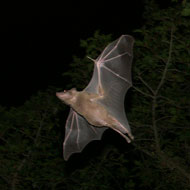
New research suggests animals have an internal navigation system
For the first time, scientists have found evidence suggesting animals have a 3D compass in the brain that acts as an internal navigation system.
In humans, vertigo and the momentary loss of our sense of direction are thought to be due to a temporary malfunction in the brain circuit that works as a 3D compass.
Research published in Nature suggests bats have neurons in the brain to help them sense which way their head is pointed.
The research team believe their findings also apply to non-flying species, including squirrels and monkeys.
Mammals have three types of brain cell - "place" and "grid" cells which act like a GPS in allowing animals to keep track of their position, and "head direction" cells which act like a compass. Previously, head direction cells have only been studied in 2D settings in rats.
Scientists from the Weizmann Institute in Israel developed tracking technology to video monitor the bats' head direction. It also allowed them to observe the movements of wild Egyptian fruit bats.
Certain neurones in the brain were only activated when the bat's head was at a particular 3D angle.
In addition, researchers discovered for the first time that the sense of vertical direction is computed separately to the horizontal direction. It is thought the 2D head-direction cells are for movement along surfaces (such as driving in a car for humans), while the 3D cells are for complex manoeuvres such as climbing trees or piloting an aircraft.
Professor May-Britt Moser, one of the 2014 Nobel Prize in Physiology or Medicine laureates, said: "This blueprint can be applied to other species that experience 3D in a more limited sense."
Image ©Wikipedia/CC BY-SA 3.0/Zoharby


 The RCVS has announced a new version of its 1CPD mobile app, with enhanced features for veterinary surgeons and veterinary nurses to record their continuing professional development.



